

Medical supply procurement is the full process of deciding what a healthcare organization needs, specifying it, choosing a supplier, contracting, taking delivery and checking performance afterward. Buyers who do it well compare total cost rather than unit price, verify compliance before they sign, and work with a supplier that already meets the standards of their market. We supply sterile single-use and reusable surgical instruments that comply with FDA, CE, MHRA, MDR and ISO standards, and we run medical equipment procurement for regulated organizations. This guide gives the routine, step by step, and shows where each step tends to go wrong.
TL;DR
- Procurement runs from needs assessment and specification through bidding, contract award, delivery and monitoring. Planning is the longest and most valuable part.
- Purchase price is only a fraction of lifetime cost. Compare total cost of ownership across every bid, using one formula.
- Verify supplier clearances, ISO certification, recall history and traceability before you award a contract, not after the first delivery.
- Rules differ by market: the US FDA, the EU MDR and UK MHRA each set their own documentation and traceability duties.
- A supplier whose instruments already meet FDA, CE, MHRA, MDR and ISO standards removes much of the compliance burden from your team.
Table of Contents
- What medical supply procurement includes
- The stages of procurement, step by step
- Compare total cost, not unit price
- Vet suppliers before you award
- Compliance checks by destination market
- Receive, inspect and monitor
- Where we fit in your procurement
- A short procurement checklist
- FAQ
- Sources
What medical supply procurement includes
The USAID Logistics Handbook defines procurement as the decision-making process for buying products. It is wider than placing an order. In public systems it is often run by a ministry of health or a central medical stores unit, and the people involved include the program unit that needs the goods, the drug or device regulator, the funders and the manufacturers.
In a hospital, clinic group, surgical center or distributor, the same cast appears under different titles: clinicians who define what they need, biomedical or clinical engineers who write specifications, finance, a purchasing lead and the receiving warehouse. Procurement works when all of them contribute at the right stage. It fails when purchasing is handed a product name and told to find the cheapest price.
For surgical work, the scope usually covers:
- Sterile single-use instruments and procedure packs for theatre, ward and community use.
- Reusable, re-sterilizable instruments, retractors, electrosurgery equipment, laryngoscopes and holloware.
- Sterilization container systems, which tie the instrument decision to your reprocessing workflow.
- Installation, training and maintenance for any equipment that needs them.
The stages of procurement, step by step
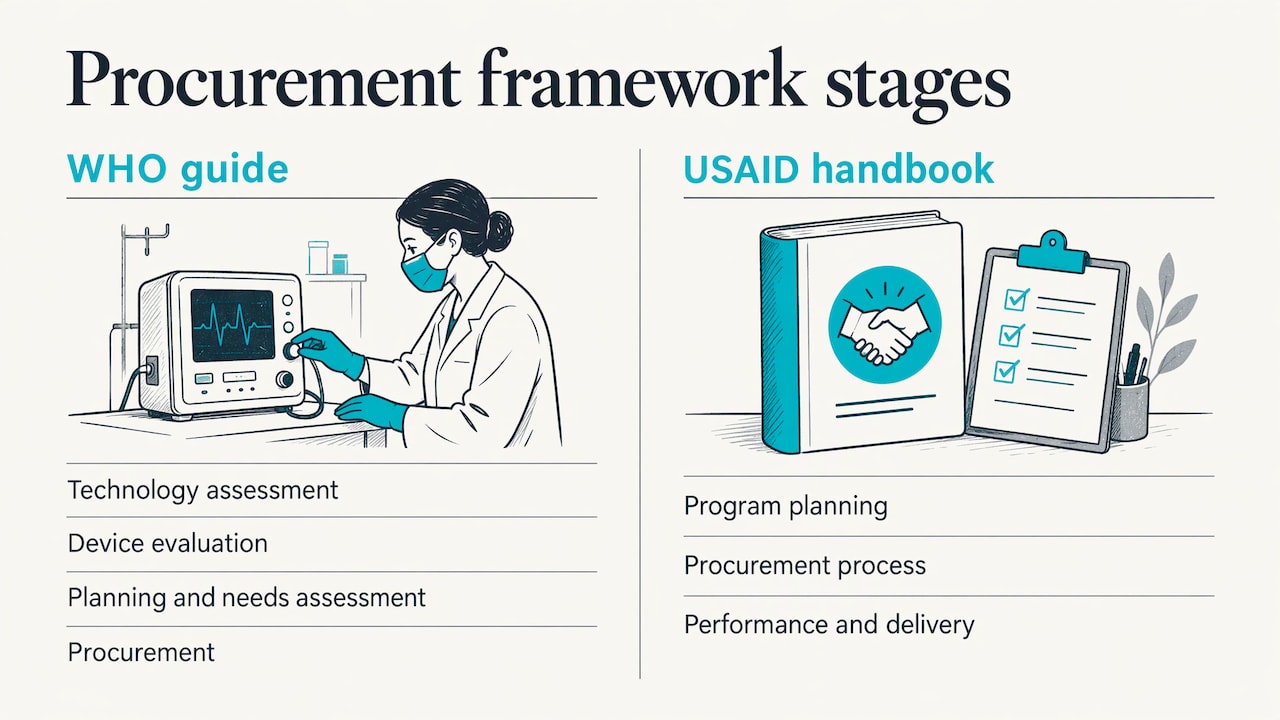
The WHO’s procurement process resource guide describes the standard sequence: technology assessment, device evaluation, planning and needs assessment, procurement, installation, commissioning and monitoring. The USAID handbook groups the work into three phases: program planning, the procurement process itself, and performance, meaning delivery of goods. Here is how that looks in practice.
1. Assess the need and build a team
WHO’s planning flowchart starts with a multidisciplinary team, market research and data gathering. Define which procedures, specialties and wards you are buying for, the quantities, and the site requirements such as sterile processing capacity or storage.
Where it goes wrong: needs are copied from last year’s order. Usage changes, and so do specialties and case volumes. Reusable and single-use items also trade off against each other, so decide the mix deliberately, with sterilization capacity in view.
2. Write specifications
Specifications are the core of the purchase. The USAID handbook says they are the main way buyers protect patients from counterfeit or substandard products, and that quality-assurance requirements in a bid should name the documents a supplier must provide, such as manufacturing records, test data and regulatory certificates, plus inspection plans.
The value-based procurement guide from ADP says specifications should be developed by biomedical engineers and clinical experts and should cover functional, performance, technical, installation, training and maintenance requirements. It also advises keeping them product-neutral so that competition stays open.
Where it goes wrong: vague wording. Saudi Arabia’s medical device guidelines stress that tender evaluation depends on how precisely needs are identified, and that vague specifications lead to poor evaluation and poor value. For instruments, specify the specialty, material (stainless steel, titanium or tungsten carbide tips), sterile or reusable status, packaging, labeling and the standards the product must meet.
3. Choose a purchase method and plan ahead
Decide whether you will run a formal tender, request quotes, or contract with a single supplier for a defined range. The USAID handbook recommends a rolling procurement plan started 24 to 36 months ahead and updated regularly. It lists quantities, delivery schedule, procurement method, key steps and who is responsible. Most clinics will not plan three years out, but the principle holds: a written plan with owners and dates prevents emergency buying at premium prices.
4. Invite bids and evaluate them
The ADP guide describes four evaluation layers: a preliminary check of administrative compliance, technical evaluation against the specification, financial evaluation on total cost, and an assessment of the supplier’s qualifications, including financial stability, capacity and a record of successful performance. The UK government’s Guide 3 adds that a bid should respond to every part of the schedule of requirements, and that bidders show audited accounts, quality manufacturing certificates and, where relevant, a letter of authorization from the manufacturer.
Where it goes wrong: scoring only on price, or letting bidders answer different questions so the offers cannot be compared. Use one pricing schedule and one scoring matrix for everyone.
5. Award the contract and define performance terms
Write the performance measures into the contract: delivery timeliness, adherence to technical specifications, labeling and packaging, and remaining shelf life on arrival. These are the indicators the USAID handbook lists for contract monitoring. Agree how disputes are handled before the first order, not after the first problem.
6. Receive, install and monitor
This step is covered in detail below. It is where a good contract becomes reliable supply.
Compare total cost, not unit price
The sticker price of equipment understates what you will spend. The ADP guide recommends a total cost of ownership formula: purchase, installation, operation, maintenance and disposal costs, minus resale value, applied the same way to every bid. In its worked example, purchase price is only 35% of a $230,000 ten-year total.
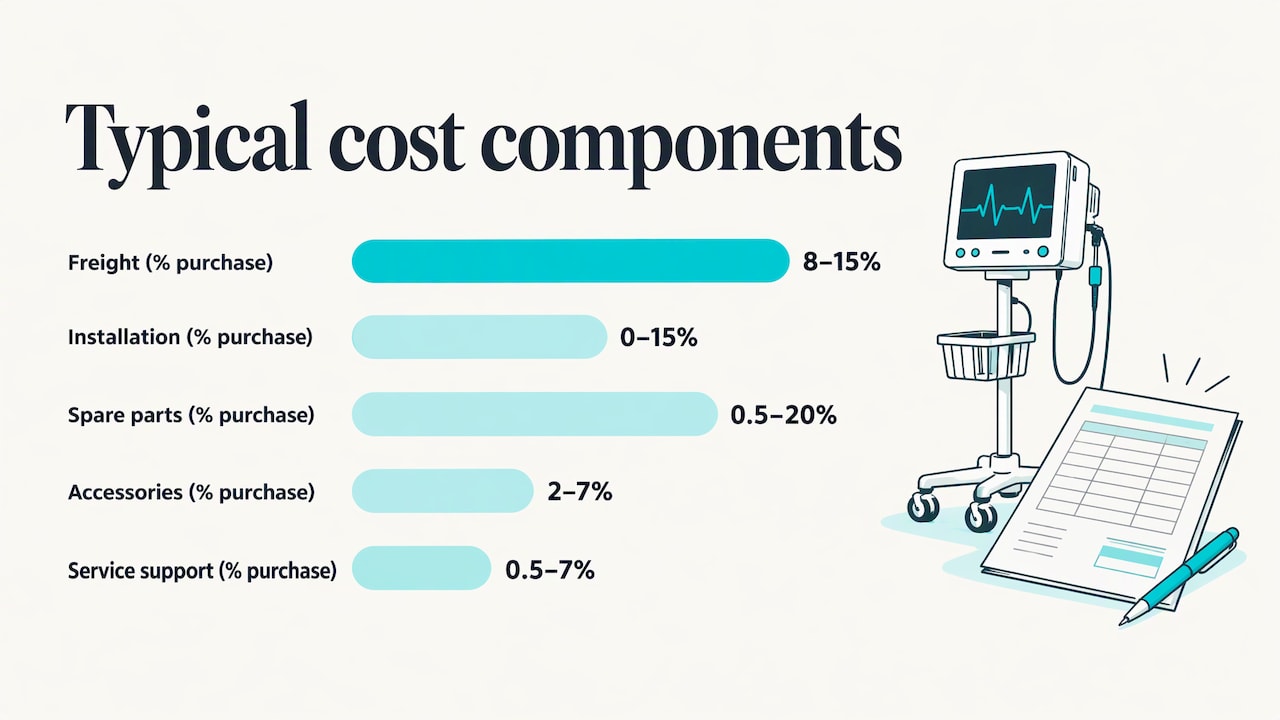
The UK Guide 3 puts the average purchase price at about 20% of overall cost of ownership. It gives these typical components as percentages of the purchase price:
| Cost component | Typical share of purchase price |
|---|---|
| Freight | 8% to 15% |
| Installation, commissioning, initial training | 0% to 15% |
| Two years of spare parts | 0.5% to 20% |
| One year of accessories and consumables | 2% to 7% |
| One year of service support | 0.5% to 7% |
| Site preparation | 0% to 10% |
| Procurement agent | 5% to 10% |
| Insurance | 1.5% |
| Contingency | 3% |
These percentages come from a 2005 UK government guide and are a framework, not a quote. Use them to remind your team which lines belong in the comparison.
For reusable instruments, add the cost of reprocessing, repair and sharpening, and container systems. For single-use items, add storage space and waste handling. The ADP guide also defines value-based procurement as maximizing value for money rather than chasing the lowest price, weighing economy, effectiveness, efficiency, equity and sustainability.
Vet suppliers before you award
A supplier assessment should answer four questions: is the product compliant, is the company stable, will it deliver on time, and will it support you afterward?
The US HIDA supplier vetting checklist is a practical starting list. It recommends verifying:
- FDA 510(k) or PMA clearances, and FDA establishment registration numbers.
- ISO 9001:2015 and ISO 13485 certification.
- GUDID participation and UDI, including manufacturing and expiration date attribution.
- FDA recall history and the most recent FDA inspection results.
- Audited financials, references and willingness to host a site visit.
- Trade Agreement Act compliance where it applies to your purchasing.
The Saudi guidelines add service-side criteria: hotline support, speed of spare-part delivery, warranty, consumables cost, and published hazard and recall data. Uganda’s national guidelines, written for a low-resource setting, go further on after-sales terms, including spare parts availability for at least seven years from acceptance and a five-year life-cycle cost analysis. If you buy equipment that needs maintenance, those are useful terms to put in your own contract.
Proportionality matters. The IMDRF’s 2025 draft guidance on supplier controls says the extent of control should match the risk of the product, and that suppliers should be re-evaluated periodically even when no problems have appeared. A box of sterile gloves and a neurosurgical instrument set do not need the same depth of audit.
Responsibility also stays with you. The same IMDRF document says that supplier control cannot be delegated away: even when an independent party performs audits, the organization keeps responsibility for its purchasing functions. That is a reason to choose a supplier whose compliance documents are complete and ready on request. Our instruments comply with FDA, CE, MHRA, MDR and ISO standards, and we support regulated organizations with NHS-approved, ISO-accredited procurement and delivery.
Compliance checks by destination market
What you must verify depends on where the product will be used or sold. For a global buyer, importer or distributor, this is the section to keep open on the desk.
United States
The FDA’s amended device quality requirements, the Quality Management System Regulation, took effect on 2 February 2026 and incorporate ISO 13485:2016 by reference. The FDA’s October 2025 draft guidance says purchasing files should set supplier evaluation and selection criteria in proportion to device risk, include a plan for monitoring and re-evaluating suppliers, and provide for verification of purchased product. In practice, ask each supplier for its clearance numbers, establishment registration and ISO 13485 certificate at the bid stage.
The FDA’s MDSAP audit guidance adds a point relevant to buyers: a changed sterilization method, structural material, sterile barrier packaging or manufacturing method can require a new 510(k), so ask suppliers to notify you of such changes.
European Union
The European Commission’s procurement factsheet states that the MDR (2017/745) became applicable on 26 May 2021. Extended transition periods for legacy devices run to 31 December 2027 for class III and most implantable class IIb devices, and to 31 December 2028 for other class IIb, class IIa and certain class I devices, including reusable surgical instruments that now need notified body involvement.
Traceability rules matter at the dock. UDI carriers were due by 26 May 2021 for class III and implantable devices, 26 May 2023 for classes IIa and IIb, and 26 May 2025 for class I, with reusable devices needing the UDI on the device itself two years after the class date. Importers must verify compliance and register in EUDAMED, the EU device database, and distributors must check compliance by representative sampling under MDR Article 14.
United Kingdom
The MHRA’s November 2024 consultation on routes to market proposed an international reliance scheme for certain devices approved in Australia, Canada, the USA or the EU, together with MHRA registration, a physical UDI on parts and labels, and new post-market surveillance rules. Check the MHRA’s own pages for the rules in force when you buy, because this area is still moving.
Grant-funded purchasing
If donor money funds your purchase, the funder may set its own rules. The Global Fund’s quality assurance policy requires manufacturing sites to comply with ISO 13485 or an equivalent system recognized by a stringent regulator, and expects quality-assurance costs to be included in grant budgets.
Receive, inspect and monitor
A contract only delivers value if receiving is disciplined. The USAID handbook describes the sequence. Before shipment, plan compliance checks at three levels: document review, visual inspection and, where the risk justifies it, laboratory or physical testing. At the warehouse, confirm the commercial invoice and packing list, inspect for correct products, quantities, condition and labeling, update inventory records, and pass the paperwork to procurement so payment can be authorized.
Track the indicators you wrote into the contract: on-time delivery, specification adherence, labeling and shelf life. Check order status before expected delivery dates so that a delay shows up as a call, not a canceled case. For sterile single-use stock, record lot numbers and expiry dates on receipt so that rotation and any recall are simple.
Review supplier performance on a fixed schedule, whether quarterly or annual, and keep the results. They become your evidence at the next tender.
Where we fit in your procurement
Procurement takes time most clinical and operations teams do not have. We supply sterile single-use instruments for dentistry, general surgery, podiatry, dermatology, cardiology, ENT and minor surgery, along with theatre supplies, community and ward packs, and neurosurgical patties. On the reusable side we supply re-sterilizable instruments for dentistry and CMF, general surgery, cardiovascular, ENT, neurosurgery, gynecology, ophthalmology, plastic surgery and orthopedics, plus retractors, electrosurgery equipment, laryngoscopes, tungsten carbide and titanium instruments, holloware and sterilization container systems. All of it complies with FDA, CE, MHRA, MDR and ISO standards.
That range means one supplier relationship can cover several specialties on the same specification and the same compliance file. Our medical equipment procurement and installation support is built for regulated organizations, and importers and distributors can talk to us about instrument supply.
If you manage orders, stock and supplier data across sites, our Medflow Dynamics healthcare operations platform is part of the same offer. To discuss a requirement, use the general enquiry form.
A short procurement checklist
- Name the clinical owner, the technical owner and the budget owner.
- Write a product-neutral specification with the standards you require.
- List the documents each bidder must supply: clearances, ISO certificates, registration numbers, UDI data.
- Use one pricing schedule that captures total cost of ownership.
- Score bids with a matrix agreed before opening.
- Put delivery, labeling, shelf-life and support terms into the contract.
- Inspect and record every delivery, then review performance on a schedule.
FAQ
What are the stages of medical supply procurement?
The usual sequence is needs assessment, specification, purchase planning, bidding, evaluation, contract award, delivery and monitoring. The WHO’s guide adds installation and commissioning for equipment. The USAID handbook groups these into planning, the procurement process and performance.
Who is involved in healthcare procurement?
Clinical users define needs, and biomedical or clinical engineers write specifications. Purchasing runs the tender, finance sets the budget, and the receiving warehouse checks deliveries. In public systems a central medical stores or ministry unit may also lead the process, with regulators and funders involved.
How do I compare suppliers fairly?
Use one specification, one pricing schedule and one scoring matrix. Evaluate administrative compliance, technical fit, total cost of ownership and supplier qualifications in turn, as the ADP guide describes. Total cost matters because purchase price can be a minority of lifetime spending.
What compliance documents should I ask for?
In the US, ask for FDA clearance or approval, establishment registration, ISO 13485 certification and UDI data. For the EU, ask for MDR conformity documentation and UDI information. For the UK, ask for MHRA registration details. Always confirm the current rules with the regulator for your market.
Can one supplier cover several surgical specialties?
Yes. We supply single-use and reusable instruments across dentistry, general surgery, cardiovascular, ENT, neurosurgery, gynecology, ophthalmology, plastic surgery, orthopedics and more, all complying with FDA, CE, MHRA, MDR and ISO standards. That lets you run one specification and one compliance file across specialties.
Sources
- The Logistics Handbook: Procurement chapter (USAID)
- Procurement process resource guide (WHO)
- Value-based procurement of medical equipment (ADP/UNDP, June 2020)
- Guide 3: How to Procure and Commission Your Healthcare Technology (UK government)
- Guidelines for Best Practices in Medical Device Management (SFDA, 2019)
- FAQ and Checklist to Vet Suppliers (HIDA)
- Quality Management System Information for Certain Premarket Submissions (FDA, October 2025)
- MDSAP Audit Approach (FDA, 2024)
- Procurement Ecosystem of medical devices and in vitro diagnostics (European Commission, 2024)
- Medical Devices Regulations: Routes to market (MHRA consultation, November 2024)
- Medical Devices and Core Personal Protective Equipment (The Global Fund)